State of the Union: Must-Know Insights from our full spectrum guidelines, Edition IV
How we’re (still) deprogramming the war on plants in 2026.
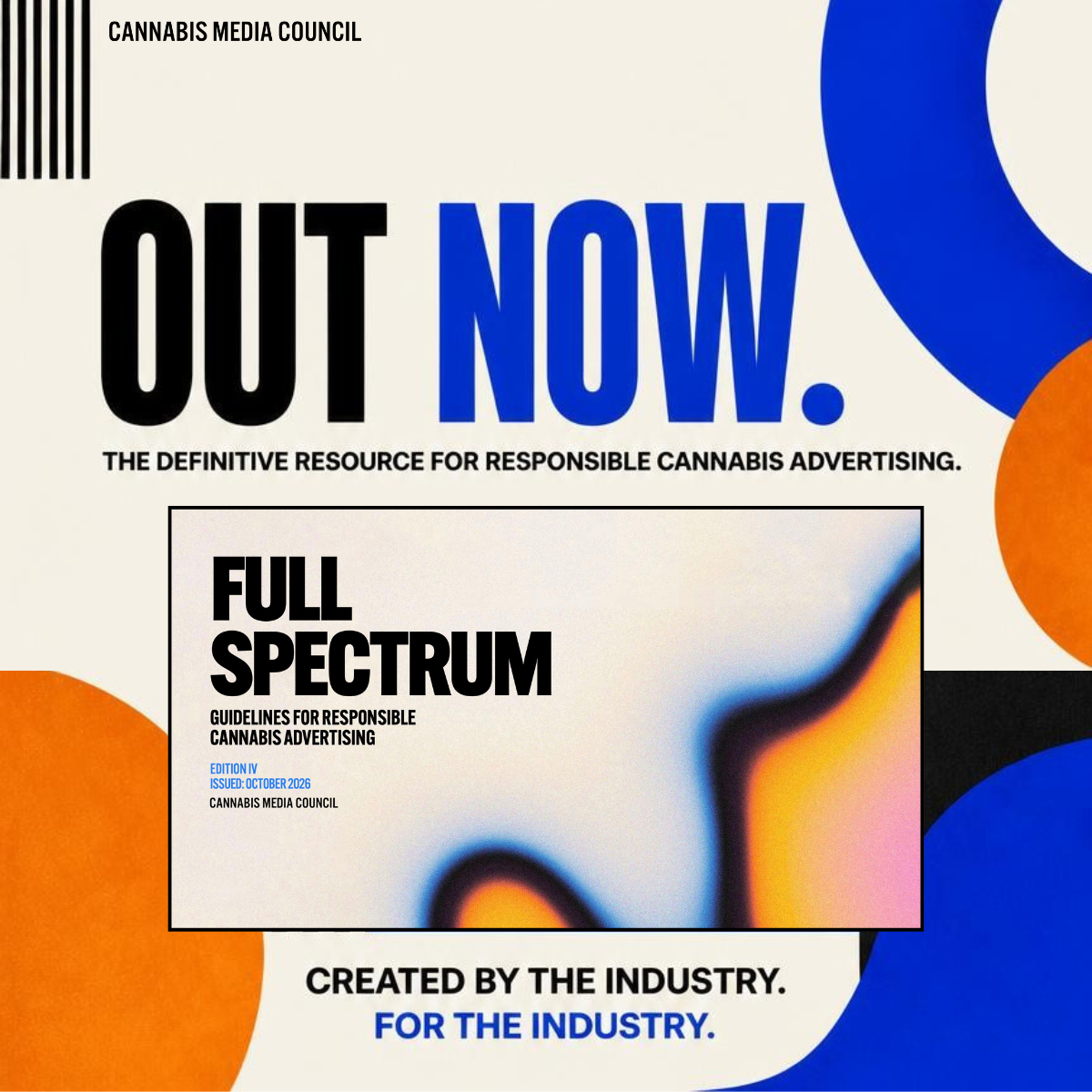
In October 2026, the Cannabis Media Council released our fourth edition of our FULL SPECTRUM: Guidelines for Responsible Cannabis Advertising! By and for the industry, this information-packed guide — free for download now — has been updated for the ever-changing cannabis landscape. New additions for 2026 include our proposed universal Cannabis Advertising Code, the results of our first industry survey of advertising investments and sentiments, new case studies, guidance on the looming federal hemp ban, and more. Below, we recap the state of the cannabis industry for 2026 and look ahead at what’s next.
As of 2026, 24 states, the District of Columbia, and the two territories of Guam and the Northern Mariana Islands have legalized adult-use cannabis for individuals 21 or older. On the medical side, 40 states, three territories, and the District of Columbia allow medical cannabis.
The cannabis industry continues to grow, with the U.S. legal market reaching roughly $34 billion in 2025 sales and projected to reach $47 billion by 2026. According to the MJBiz Factbook 2026, total economic impact is projected to reach $123.6 billion.
The Leafly Jobs Report 2026 puts the US legal cannabis industry at 445,800 full-time equivalent jobs in 2025, up 1.2% which was the industry’s first positive jobs year since 2022. As the mature West Coast markets shed cultivation jobs, New York more than doubled its cannabis workforce, while Maryland, New Jersey, Minnesota, Illinois, and Ohio came in strong.
Yet this burgeoning industry and many of the ancillary businesses that support it are severely restricted from using the majority of traditional advertising channels to promote and educate consumers about their brands, products, and services.
“Now over 79% of Americans live in a county with at least one cannabis dispensary, and 74% live in a state where cannabis is legal in some form.”
Now over 79% of Americans live in a county with at least one cannabis dispensary, and 74% live in a state where cannabis is legal in some form. Despite this, the Federal Trade Commission continues to restrict cannabis companies from advertising. Advertising is a tried-and-true part of the traditional marketing mix. Paid media enables marketers to share precise information about their products and services to reach targeted audiences through transactional and scalable means.
Paid media is an impactful way to engage with new consumers through trusted sources to foster consideration and stay top of mind, ultimately inspiring business growth.
While it’s a well-documented fact that the war on drugs was a policy failure, its reverberations still influence how cannabis is viewed under the lens of media and advertising. Who over the age of 30 doesn’t recall the propaganda campaigns of fried eggs and deflated friends?
Suffice it to say: Americans have been misinformed and unfairly punished, and many continue to be imprisoned or locked out of the industry due to racist, unscientific policies, and propaganda.
When an industry is tightly regulated, heavily taxed, outrageously censored, and effectively cut off from mass marketing, a landscape of missed opportunities emerge.
Over 54 million consumers were served this past year, ringing in an estimated 34,800,000 customers monthly, as 55% of US adults now live in an adult- use state.
“More Americans report using cannabis on a daily or near-daily basis than either alcohol or cigarettes.”
In 2026 a Pew Research Center survey reported 88% of U.S. adults believe marijuana should be legal for either medical or adult use.
For the first time since the federal government began tracking substance use, more Americans report using cannabis on a daily or near-daily basis than either alcohol or cigarettes. According to the 2025 National Survey on Drug Use and Health published by SAMHSA, there are now 21.4 million daily or near-daily cannabis users in the U.S., compared to 17.2 million daily alcohol drinkers and 19.9 million daily cigarette smokers.
Hemp THC beverages were the headliners for providing new elevating alternatives for Lollapalooza and other major concert revelers, along with Chicago’s United Center becoming the first U.S. arena to expand concessions to sell hemp-THC beverages to guests 21 or older. A clear signal of demand and desire for more adult beverage varieties, in addition to the proliferation of inventory across the US.
And high-fives all around! The 2026 WNBA Collective Bargaining Agreement removed cannabis from the league’s prohibited substances list and now permits players to hold passive investment and endorsement relationships with cannabis companies. The players included “Remove Marijuana Testing” as one of the 37 requested improvements, signaling that cannabis use is important to their lives and livelihoods.
Yet . . .
Cannabis marketing spend remains stuck at roughly 4–6% of operating budgets, half of what consumer packaged goods (CPG) and traditional retail invest. Even as the regulated cannabis market grew to a forecasted $34B in 2025, the share of revenue cannabis operators reinvest in marketing has not closed the gap with mainstream industries. (Surfside)
The retail media gap is widening, not closing. CPG brands now allocate 40%+ of marketing budgets to retail media, while cannabis brands still direct less than 20%, meaning cannabis operators are under-indexed on the single fastest-growing channel in commerce. (Surfside)
Dispensary marketing spend as a share of revenue remains 70%+ below the broader retail vertical, even as dispensary operators face the most intense competition for consumer dollars in the industry’s history. (Surfside)
Cannabis brands activating onsite retail media on dispensary ecommerce surfaces are seeing 10x+ higher return on ad spend (ROAS) than off-site display alone. Yet fewer than 1 in 4 cannabis brands have activated an onsite retail media strategy, leaving the channel with the highest measured efficiency in the industry largely untapped. (Surfside)
Personalized shopping experiences are becoming table stakes for dispensaries. In mature markets, retailers deploying SKU-level personalization on their ecommerce menus are seeing +15% lifts in average basket size and +20% lifts in conversion rate, while operators relying on static, one-size-fits-all menus are losing share. (Surfside)
Learn more when you download the fourth edition of the Cannabis Media Council’s FULL SPECTRUM: Guidelines for Responsible Cannabis Advertising!
